



Land-Con | Landscape Ontario and BILD member, ICPI certified | Last updated: November 23, 2026

Interlocking is paving made of individual concrete or stone units laid in a pattern over a compacted base and bedding sand. The units lock together through the sand in the joints and the restraint around the edge, so the surface carries load as one. The part you see is the pattern. The part that decides how long it lasts is underneath.
Land-Con is an interlocking company in Toronto that also designs what it builds. If you are planning an interlocking patio for the backyard, a new driveway or a front walkway and steps, our residential interlock installation service covers the design, the excavation and the install, and we explain each stage in plain language.
Book a Free ConsultationCall 416.504.5263
Residential Interlocking and Interlock Installation in Toronto
Our interlocking services in Toronto cover the surfaces below, and most projects combine two or three of them, so we plan them together.
Interlocking Patios
Backyard patios and terraces for dining, lounging and outdoor kitchens, in concrete pavers or natural stone.
Interlocking Driveways
Driveways built on a deeper base with edge restraint, laid to drain away from the house.
Walkways, Steps and Porches
Front entries, side-yard paths and steps that match the house and stay safe underfoot.
Pool Decks and Surrounds
Pool patios and coping areas planned with the pool excavation, drainage and fencing.
Retaining Walls, Pillars and Curbs
Segmental retaining walls, pillars and curbs built with the same units as the paving.
Permeable and Alternative Surfaces
Permeable interlocking where stormwater matters, and stamped concrete where it suits better.

Interlocking Patios and Patio Stones
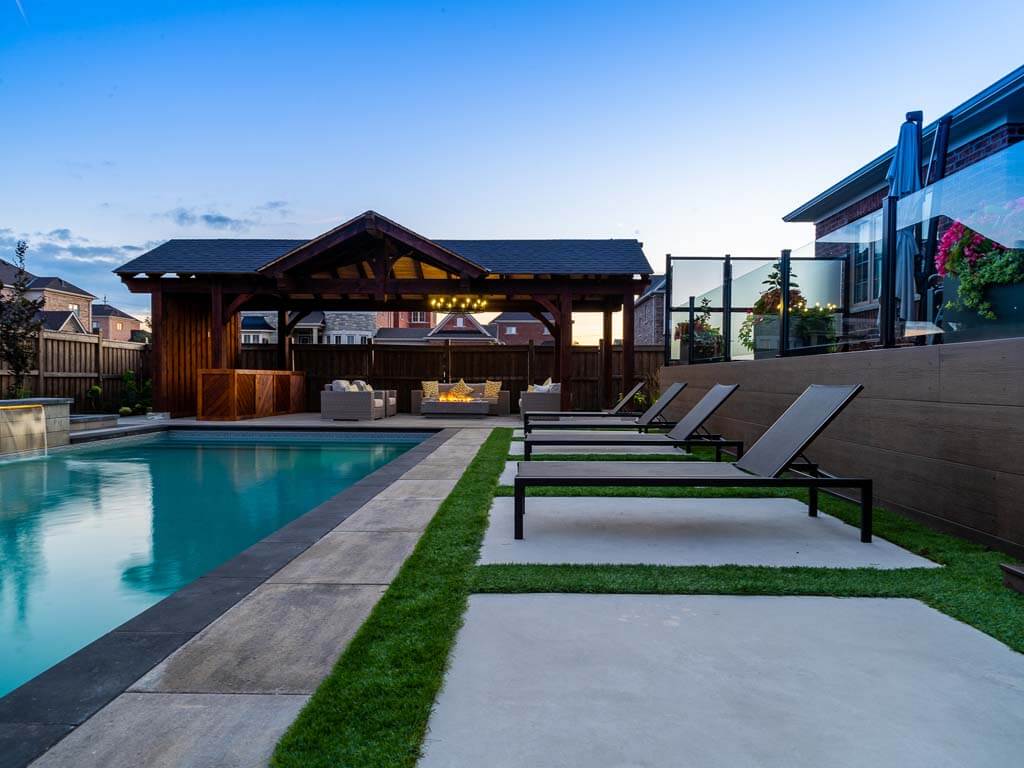
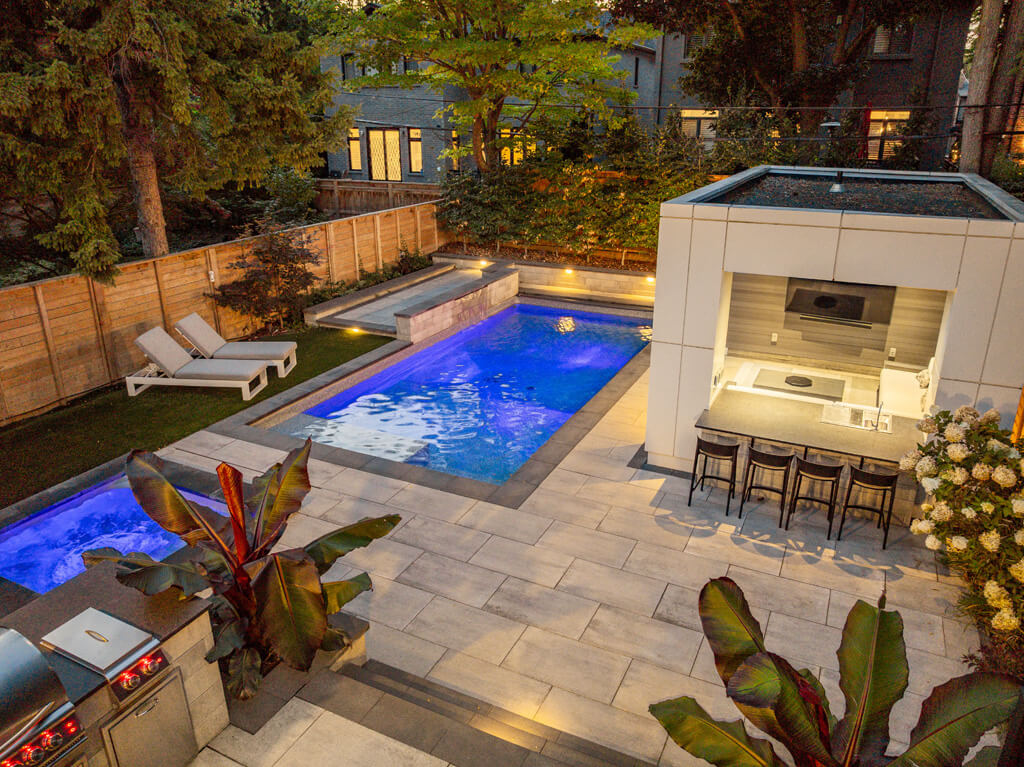
A backyard interlock patio is where interlocking earns its keep. It takes furniture, planters, a barbecue and foot traffic, and it can be shaped around curves, steps and a pool in a way a poured slab cannot. When we design a backyard interlocking patio, we start with how you use the yard: where you eat, where the sun lands in the afternoon, how you get from the door to the garden. The size, the pattern and the paver follow from that. Interlocking patio stones come in many sizes, so the same patio can read as formal, modern or relaxed depending on the pattern and the stone you choose.
Pattern and colour are worth thinking through early. A simple pattern with a contrasting border is quick to lay and easy to repair. A more complex layout looks custom, and needs more cutting and more time. Lighter colours generally stay cooler underfoot in full sun, which matters around a pool or on a south-facing terrace. Our landscape design service puts these options in front of you as a plan before we dig.
Interlocking Driveways
A driveway carries a car, so it needs more underneath than a patio. Technical guidance from the Concrete Masonry & Hardscapes Association (CMHA) puts the minimum compacted base at 4 inches for a patio or walkway and 6 inches for a residential driveway on well-drained soil, and poorer ground needs more. The surface also has to drain: a general minimum slope of 1.5% keeps water moving off the pavers instead of sitting on them.
The edge matters as much as the middle. A driveway sees turning tires, which push sideways, so the border needs a proper restraint that holds the units in place. For pattern ideas, paver options and a look at how interlock compares with concrete and asphalt, read our guide to interlock driveway designs and ideas in Toronto.
Walkways, Steps and Front Entries
The front walkway and steps are the first thing visitors use. They need good traction, a slope that sheds water and riser heights that stay even, which is easy to get wrong when the base is rushed. An interlocking walkway or garden pathway suits curved routes and wide landings, and it blends with planting beds and a front-yard design, which is where interlocking and landscaping come together. Paver thickness differs by use: some units are made for pedestrian areas and others for vehicles, and we match the unit to the area, so a walkway paver does not end up under a car.

Pool Decks, Retaining Walls and Pillars
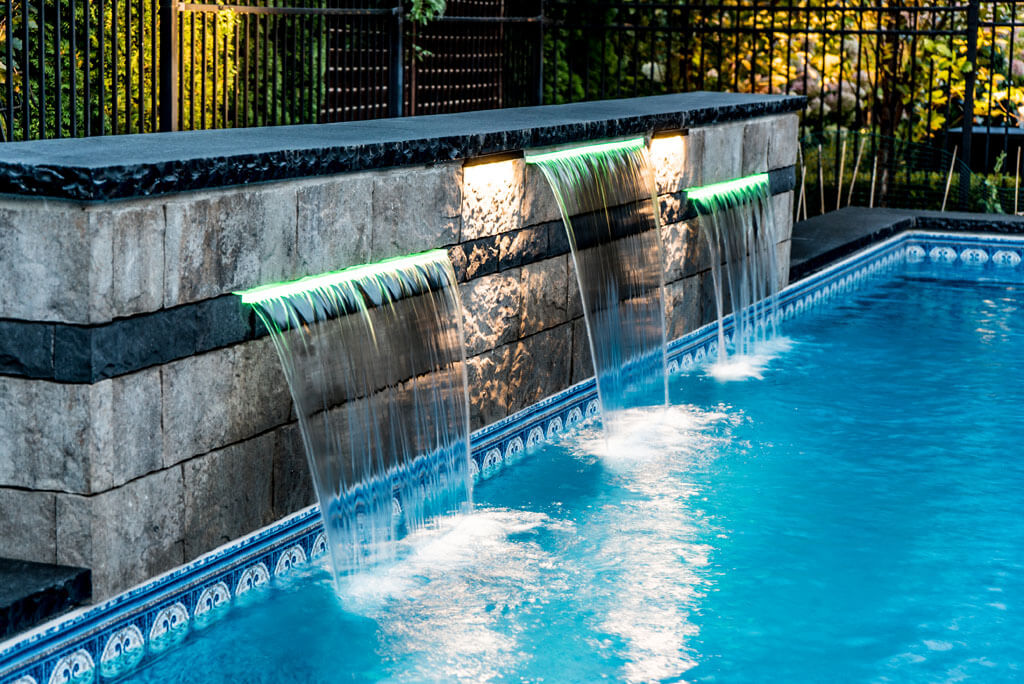
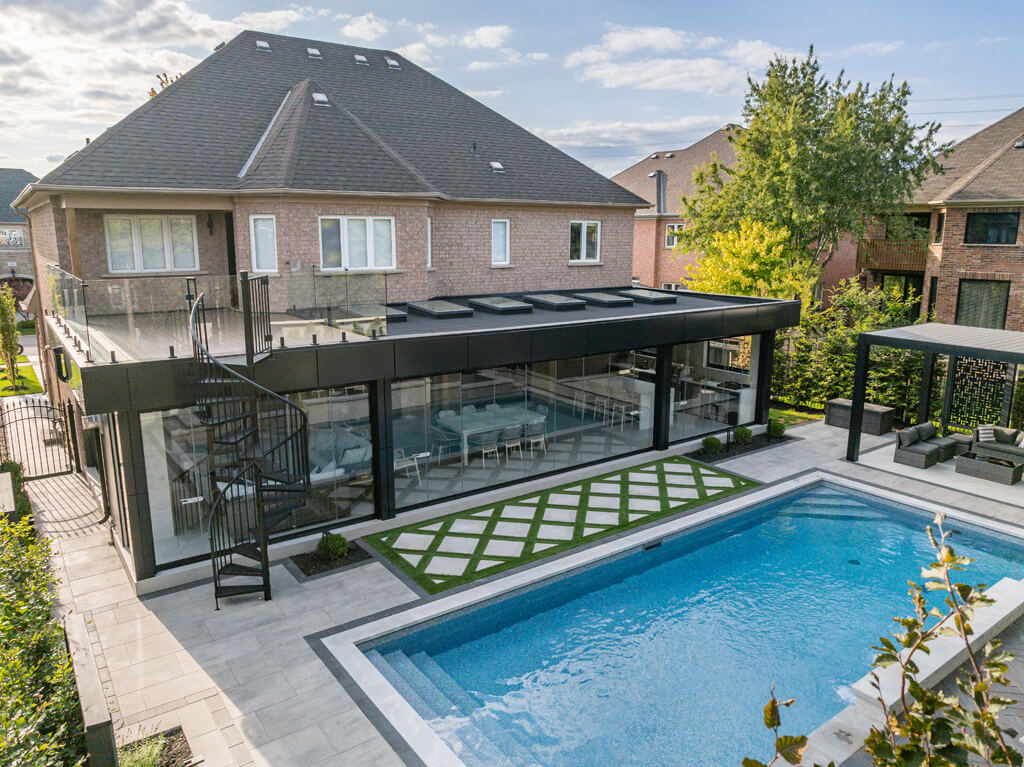
Around a pool, the paving, the drainage and the structure all depend on each other. The pool excavation sets the levels, the deck has to slope away from the water, and the fence line affects the layout. We plan the pool deck with the pool, so the two do not fight each other on site. On a sloped lot, the same segmental units can build retaining walls, steps and pillars, and Land-Con is an NCMA certified SRW installer. Tall or heavily loaded walls can need engineering and approvals, and we flag that early.
Interlocking Stone: Concrete Pavers, Natural Stone and Brick
Interlocking stones come in a few families. Interlocking pavers in Toronto are most often concrete. They come in many shapes, sizes, colours and textures, and they are made to consistent dimensions, which helps with a tight, even surface. Natural stone gives a patio or step more character, with each piece cut and fitted by hand, and it suits entries and a stone patio where the look comes first. Interlocking brick, meaning clay brick pavers, has a traditional appearance that suits older homes.
The right material depends on how the area is used, the style of the house, the budget and how much maintenance you want to take on. Ask to see the colour and texture in person, in your own light, before you decide, because a photo rarely matches a finished surface.
How an Interlocking Surface Is Built
Most failures that homeowners see, such as sunken patches, wavy lines and pavers that have spread apart, come from the work nobody sees. This is the order we build in. The numbers below are CMHA technical-guidance minimums, and we set the actual specification for your site.
Nothing in this list is exotic, and that is the point. A good interlocking job is the standard method done carefully, with the base, the slope and the edge taken seriously. For how this fits the wider build, see our guide to what landscape construction includes, and why drainage matters in landscape design.

Ontario Winters, Road Salt and Snow Clearing
Toronto weather puts a surface through freeze-thaw cycles, road salt and snow clearing. Interlocking handles this well when it is built correctly, because the units are separate and a settled area can be lifted and reset. The weak points are the ones above: a thin base, poor drainage or a loose edge. CMHA suggests repairing any heaved or lifted unit that sits more than 1/8 in. (3 mm) proud before winter, so a snow shovel or plow blade does not catch it.
Shovel or plow diagonally to the joints, use a plastic shovel or a blade with a guard, and keep de-icer to a minimum. CMHA names rock salt as the preferred de-icer, allows calcium chloride when needed and does not recommend magnesium chloride or calcium magnesium acetate, since they can damage concrete. Some paver manufacturers advise stricter limits, so check the guide for your product. In spring, sweep off leftover de-icer and winter sand, which can scuff and discolour the surface.
Maintenance and Repairs
Interlocking is low maintenance, not no maintenance. CMHA recommends a routine in spring and fall:
- Sweep. Clear debris in spring and fall, taking care not to pull out joint sand.
- Top up the joints. When the sand has dropped more than 1/2 in. (12 mm) below the chamfer, add dry masonry sand.
- Inspect twice a year. Look for sunken areas, ponding and loose edges, ideally during or just after rain.
- Clean with care. Test any cleaner on a small hidden area first, and avoid steel-bristle brushes, which can rust and stain the surface.
Cosmetic changes are normal. Efflorescence, the whitish haze that can show on new concrete pavers, does not affect strength and usually fades. Sealing is a choice, not a requirement. If a patch does sink, the repair is to lift the pavers, correct the base and relay them, which is cheaper and tidier than breaking out a slab.
Interlocking, Concrete or Asphalt?
All three work, and the right one depends on the site. Poured concrete is smooth and solid, and it cracks as a slab, so a repair shows as a patch. Asphalt usually costs less up front for a long driveway, and it needs resurfacing over time. Interlocking costs more up front, and each unit can be replaced or relaid, the colour and pattern options are far wider, and the surface can be opened for utility work and put back. Our interlock driveway guide, linked above, sets the three side by side.
What Affects the Cost of an Interlock Project
Interlocking prices vary more than most people expect, because the visible paving is only part of the job. The main drivers are the area, the pattern and cutting, the paver or stone chosen, the depth of excavation and base, removal and disposal of the old surface, access for equipment, edging, steps, drainage and any approvals. A low per-square-foot price from an interlocking contractor often leaves out base depth or edging, which is where problems start. Our guides to backyard landscaping cost and the cost and value of landscape upgrades explain the factors. After a site visit you receive a written, itemized proposal you can compare line by line.
Rules and Utilities to Plan For
Three things shape most interlocking jobs before a single paver goes down. Details vary by municipality and lot, so we verify them for your address.
How Our Process Works, From First Visit to Finished Surface
We follow a four-phase landscape design and construction process on every project.
- Vision. We come to the property, learn how the area will be used and look at the site, access and budget.
- Design and consultation. We draw the plan, set out pattern, paver and colour options and put the scope in a written proposal.
- Construction. Locates, excavation, base, bedding, laying, edging, compaction and joint sand, in that order.
- Post construction. We finish with a walk-through and care notes for the surface you now own.
Why Homeowners Choose Land-Con
- Built on a new base. Every interlock installation is installed on a new base, with edge restraint and polymeric sand.
- One firm from drawing to finished surface. The people who set the pattern, levels and drainage are the ones who build them.
- Certified. ICPI certified, an NCMA certified SRW installer, and a member of Landscape Ontario and BILD.
- Reviews. 4.9 out of 5 from 124+ HomeStars reviews, and an award-winning firm.
- Five-year transferable workmanship warranty on structural work.
See finished work in our featured projects, or read how hardscape and softscape work together. For the full build behind a project, visit our residential landscape construction page.
Interlocking Across Toronto and the GTA
We install interlocking across Toronto and the Greater Toronto Area, from North York and Etobicoke to Oakville and Burlington. Pick your area for the local page.
Frequently Asked Questions About Interlocking in Toronto
What is interlocking, and what can be built with it?
Interlocking is paving made from pre-cast concrete units, or natural stone, laid in a pattern over a compacted base and bedding sand, with sand-filled joints and a restraint around the edge. In Toronto it is used for patios, driveways, walkways, steps, pool decks, porches, pillars, curbs and retaining walls.
How deep should the base be under interlocking?
CMHA technical guidance sets minimums on well-drained soil of 4 inches (100 mm) of compacted base for patios and walkways and 6 inches (150 mm) for residential driveways. Wet or freeze-thaw ground can need a deeper base, and a geotextile is often added. We set the depth after we see the site, because the base decides how the surface behaves for years.
Will interlocking shift or sink in an Ontario winter?
It can if the base, the drainage or the edge restraint was done poorly. A properly built surface has a compacted base, a slope that sheds water and an edge that holds the pavers in. Because the units are separate, a section that does settle can be lifted, the base corrected and the same pavers laid back, without breaking out the whole area.
Is it better to seal interlocking pavers?
Sealing is optional. A sealer protects against stains, oil and water, but it does not add strength. CMHA advises sealing only after stains and efflorescence are cleaned off and the surface is fully dry, and some sealers can turn cloudy if moisture is trapped. Check what your paver manufacturer recommends before you decide.
What is the white haze on new pavers?
That is efflorescence, a whitish deposit that comes from the cement in the concrete reacting with the air. It is cosmetic, it does not affect strength or durability, and it often fades by itself. CMHA notes it can peak around 60 days after installation, and some manufacturers say it can appear for 12 to 18 months. If it bothers you, use a product made for it and test it first.
How do I stop weeds growing between pavers?
Weeds seed into joints from dust and debris, so the best defence is full, stable joints. We fill them with polymeric sand, which locks the sand in place and slows weed growth and washout. Sweep debris off regularly, and top up the joint sand when it drops.
Can interlocking be installed over an existing concrete slab or asphalt?
Sometimes. The old surface must be sound, level and draining in the right direction, and the new height must suit doors, steps and drains. We assess the surface at the site visit. If it is cracked, heaved or holding water, removing it and building a new base is usually the better result.
Can interlocking be used on a steep driveway?
Yes, with the right detailing. CMHA recommends stabilizing the joint sand on slopes steeper than 7% to resist wash-out, and every surface needs a slope for drainage, with 1.5% as a general minimum. Edge restraint and a well-compacted base matter even more on a grade.
Which de-icer is safe to use on interlocking?
Use de-icer sparingly. CMHA names rock salt (sodium chloride) as the preferred choice, allows calcium chloride when quick action is needed, and does not recommend magnesium chloride or calcium magnesium acetate because they can damage concrete. Some paver makers give stricter advice, so follow the guide for your product. Shovel or plow diagonally to the joints so blades do not catch the edges.
Are interlocking pavers permeable?
Standard interlocking is not a permeable system. Water is shed by the slope of the surface and the drainage plan around it. Permeable interlocking is a separate design with open joints and a stone reservoir under it. If drainage or stormwater is a priority, tell us and we will look at that option.
How much does interlocking cost in Toronto?
Cost depends on the area, the pattern, the paver or stone, the excavation and base depth, removal of the old surface, access for equipment, edging, steps and drainage. We do not quote a per-square-foot figure without seeing the site, because the base and access can change the price more than the pavers do. After a visit you receive a written, itemized proposal.
What should I compare when I get interlocking quotes?
When you compare interlocking companies in Toronto, check the base depth and material, and whether geotextile is included. Then look at the bedding sand, the edge restraint and the joint sand type. Finally, ask what happens to the old surface and soil, how drainage is handled and what the written warranty covers. A low quote that leaves out base work or edging is not the same job as a higher one that includes it.
Do I need a permit for an interlocking patio or driveway?
It depends on the work and the municipality. A patio at grade often needs none, but zoning rules, drainage and tree protection still apply, and work that changes grade, touches the street side of the property or adds a structure can need approval. Once we have seen the lot, we tell you what is likely to apply and confirm it with your municipality.
How long does an interlocking installation take?
It depends on the size, the amount of excavation, access and the weather. A small walkway can be quick, and a full driveway with a new base takes longer. We give you a written schedule once the scope is settled instead of a general figure.
Which areas do you serve for interlocking?
We build interlocking across Toronto and the GTA, including North York, Etobicoke, Vaughan, Markham, Richmond Hill, Aurora, Mississauga, Oakville and Burlington. Send us your address and we will confirm we can take the project.
Is there a warranty on interlocking work?
Land-Con provides a five-year transferable workmanship warranty on structural work. We go through what is covered, and what is not, in the written proposal before you sign.
Plan Your Interlocking With Land-Con
Tell us what you want paved. We will look at the ground, the slope and the access, and explain what will hold up. A written proposal follows, and there is no obligation to go ahead.
Or call 416.504.5263 or email info@landcon.ca.