


Land-Con | Landscape Ontario and BILD member, ICPI certified | Last updated: November 13, 2026
Concrete is the most practical paving material there is, and it does not have to look like a parking lot. With colour and a pattern, a poured slab can look like slate, flagstone, cobblestone, brick or even wood planks, and it comes without the joints that weeds and ants like to use.
If you are looking for a stamped concrete contractor in Toronto, or you are comparing a concrete patio, driveway or walkway against other paving, Land-Con can design the surface together with the rest of the landscape. We plan the base, the drainage and the joints first, because they decide how the slab looks in ten years.
Book a Free Site VisitCall 416.504.5263
Stamped Concrete Services in Toronto
Stamped concrete suits more places than most homeowners expect. These are the surfaces we are asked about most.
Stamped Concrete Patios
A seamless patio with a stone, slate or brick pattern, sized for dining, lounging and the way the yard flows.
Stamped Concrete Driveways
A driveway with a patterned border or full pattern, built with the base, thickness and joints that vehicle loads require.
Walkways and Front Steps
Walkways, stoops and steps that match the entry, with textured, safer surfaces for wet and icy weather.
Pool Surrounds
A pool deck in a non-slip finish with drainage planned toward the edges, not the pool.
Porches and Slabs
Porch floors, side-yard paths and slabs on grade, finished to match the rest of the hardscape.
Planters and Features
Stamped planters, seating walls and edge details that tie the paving to the landscape.
What Is Stamped Concrete, and How Is It Made?
Stamped concrete, sometimes called imprinted or textured concrete, is regular exterior concrete finished by hand. Colour is mixed into the concrete or added to the surface, a release agent keeps the stamps from sticking and rubber stamps are pressed into the surface while it is still workable. Once the concrete cures, the surface is cleaned and sealed. The same technique has been used since the 1950s, and today’s stamp libraries and colour systems are far wider than the early ones.
The result depends less on the pattern than on the work underneath it. A stamped slab is only as good as the base it sits on, the mix that was poured and the joints that control cracking.
Patterns, Colours and Finishes
Stone and Slate
Random stone, ashlar slate and flagstone patterns give the look of natural stone with a continuous surface.
Brick and Cobblestone
Running bond, herringbone and cobble patterns suit traditional homes, entries and driveway borders.
Wood Plank
A plank pattern gives the look of weathered boards without the rot, splinters or staining.
Modern and Large Format
Large slab or tile patterns with narrow joints give a clean, contemporary walkway or patio.
Colour is usually a base tone with a contrasting accent, which gives the surface depth and hides dirt better than a single flat colour. We help you pick a palette that matches your brick, stone and roof so the paving looks like part of the house. A satin or matte sealer is usually the better choice outdoors, with a non-slip additive for pools and steps.
How We Install Stamped Concrete
The steps are simple, but each one affects how long the surface lasts. Our detailed step-by-step stamped concrete patio guide goes through them in more depth.
- Excavate and prepare the base. We remove topsoil and soft material and build a compacted granular base that drains.
- Set forms and reinforcement. Forms define the shape and slope, and reinforcement is added where the loads call for it.
- Pour and finish. An exterior mix suitable for freezing conditions is placed and levelled, and colour is added.
- Stamp the pattern. Release agent is applied, and stamps are pressed in while the surface is still workable.
- Cut control joints. Joints are placed along the pattern so that any cracking follows a planned line.
- Cure, clean and seal. After the concrete cures, we clean the surface and apply sealer, with a non-slip additive where needed.
Stamped Concrete in Ontario Winters
Toronto’s freeze-thaw cycles are hard on every paving material. Water gets into the surface, freezes and expands, and over many winters that can cause cracking and flaking. Most of the protection is built in during installation.
- A drained, compacted base. Water that cannot drain under the slab is what lifts and cracks it.
- The right mix. Exterior concrete exposed to freezing and de-icing salts is specified as an air-entrained mix designed for that exposure.
- Control joints. They give the slab a place to move without random cracks.
- Sealer. It limits water and salt getting into the surface and is renewed over time.
- Sensible winter care. Use a plastic shovel, avoid heavy use of de-icers (especially in the first winter) and rinse the surface in spring.
Drainage matters as much as the concrete itself, and our post on drainage in landscape design explains why. Concrete is poured from spring to fall, and winter work needs special cold-weather practices, which our guide to installing hardscapes in winter covers.
Stamped Concrete or Interlocking Pavers?
Many Toronto homeowners are choosing between stamped concrete, interlocking pavers and natural stone. All three work, and each has trade-offs.
Stamped Concrete
A continuous surface with no joints between units, available in many patterns and colours. A cracked section is harder to repair invisibly, and the sealer needs periodic renewal.
Interlocking Pavers
Individual units that can be lifted and reset, with a durable surface that flexes with the ground. There are joints that need sand and occasional weed control.
Natural Stone
The most authentic look and texture, usually at a higher material cost and with more installation work.
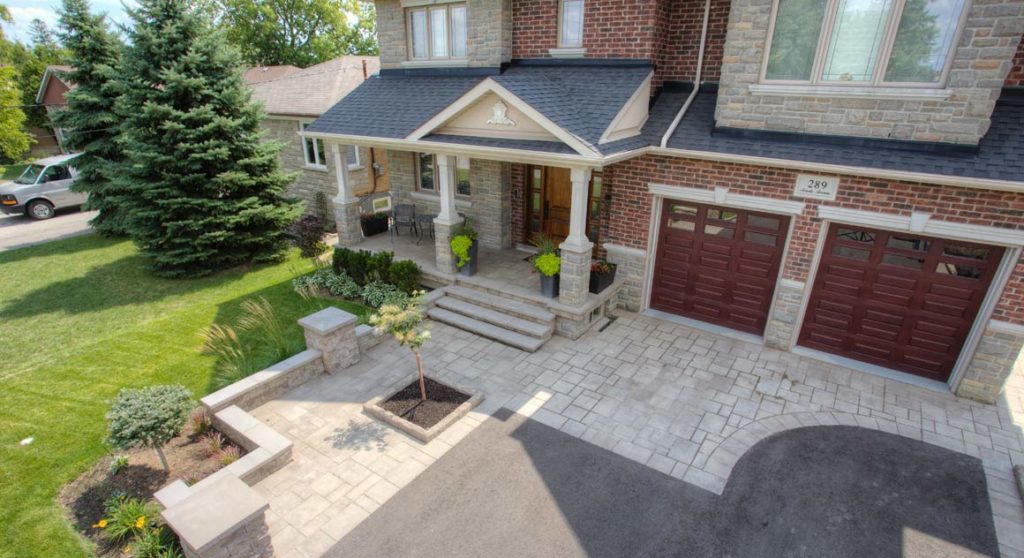
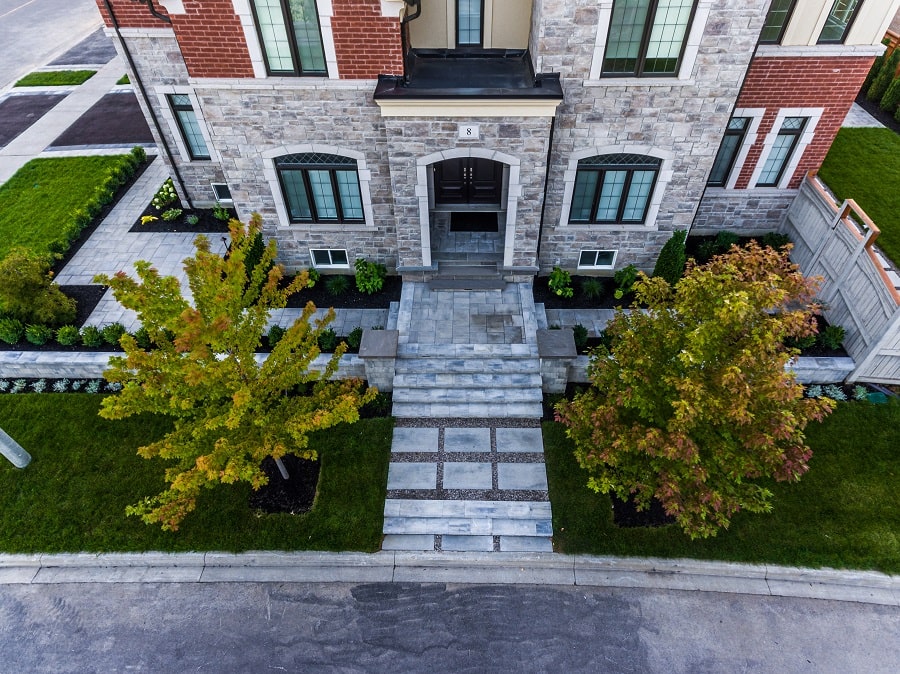
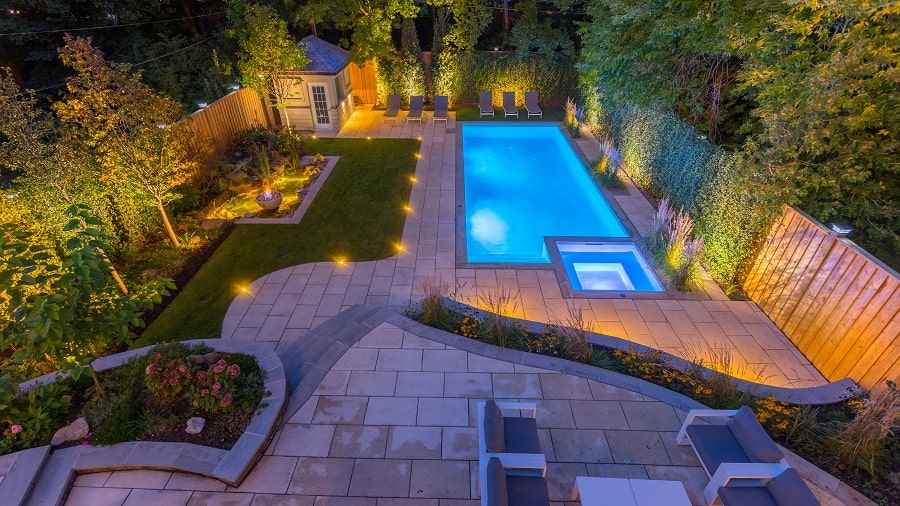
If you are leaning toward pavers for a driveway, our guide to interlocking driveway designs and ideas in Toronto shows what is possible. The photos below show Land-Con driveway, walkway and patio projects in paver and stone, so you can compare finishes. Ask us for stamped concrete samples at your site visit.
Care and Sealing: Keeping It Looking New
- Wash regularly. Sweep and rinse the surface through the season, and use a mild cleaner for stains.
- Reseal on schedule. Industry guidance suggests every 2 to 5 years, sooner for driveways. Let the surface dry fully before sealing.
- Choose the right finish. A satin or matte finish with a non-slip additive is safer around pools and on steps.
- Follow the winter routine above. A plastic shovel, light use of de-icers and a spring rinse protect the sealer.
- Fix small issues early. Fill hairline cracks and reseal before water can get in.
At the end of each project we leave you with written sealing and care advice for your surface.
Rules and Planning for Concrete in Toronto
Concrete work often touches property lines, the street and underground services. These checks come from the City of Toronto and Ontario One Call, and they change over time, so we confirm the current requirement for your address.
What Affects the Cost of Stamped Concrete
Costs vary with the project, so we explain the drivers instead of quoting a figure before we have seen the site. The main ones are the area, the thickness and reinforcement, the amount of excavation and base work, the pattern and colour system, borders and accents, truck and pump access and the sealer. Stamped concrete often costs less than natural stone, but the comparison with pavers depends on the pattern and the site, so we price both when you are undecided. You get a written, itemized proposal after the site visit.
How We Work With You
Every project follows our four-phase landscape design and construction process. For stamped concrete it looks like this.
- Vision. We visit the site, measure it and talk about how you use the space. We check the grade, the drainage, the access and the trees.
- Design and consultation. We prepare a plan with the layout, pattern and colour options, and we show you samples. You review the plan, and we adjust it with you.
- Construction. Our crew prepares the base, places and finishes the concrete and stamps the pattern, then cures and seals the surface.
- Post construction. We walk you through the finished surface, give you the curing and sealing schedule and stay available after the project closes.
Why Homeowners Choose Land-Con for Stamped Concrete
- Paving planned with the landscape. We can combine the concrete with a lighting plan, a deck, steps, walls and planting.
- Base first. We spend as much time on drainage, compaction and joints as on the pattern.
- Honest options. If pavers or stone suit your site better, we tell you.
- A written proposal and a clear schedule for cure and sealing.
Our landscape designers and architects lead each design. You can see finished work in our featured projects, read about our awards and learn more about the team on our about page. For commercial properties, see our commercial and condo landscaping service.
Stamped Concrete Across the GTA
We design and install stamped concrete in Toronto, Vaughan, North York, Etobicoke, Richmond Hill, Markham, Aurora, Newmarket, Oakville, Mississauga, Burlington and across the Greater Toronto Area. Choose your area to see our local landscaping services.
- Toronto
- Vaughan
- North York
- Etobicoke
- Richmond Hill
- Markham
- Aurora
- Newmarket
- Oakville
- Mississauga
- Burlington
Frequently Asked Questions About Stamped Concrete
How much does stamped concrete cost in Toronto?
The price depends on the area, the pattern and colour system, the thickness and reinforcement, how much excavation and base work the site needs, the access for the concrete truck, and the sealer. Complex patterns, borders and multiple colours add labour. We give you a written, itemized proposal after a site visit instead of a per-square-foot number over the phone.
How long does stamped concrete last?
Well-installed concrete on a compacted base can last for decades, but the coloured surface and sealer are the parts that wear. Sealer needs renewing every few years, and the surface should be protected from harsh de-icers. How long yours lasts depends on the base, the mix, the drainage, the traffic and the care it gets.
How often do I need to seal stamped concrete?
Industry guidance puts resealing at roughly every 2 to 5 years, and sooner on driveways or other high-traffic areas. Wash the surface and let it dry fully before sealing, and reuse the same type of sealer where you can. We tell you which sealer we use and when to renew it.
Is stamped concrete slippery?
A glossy sealer can be slippery when wet, particularly around pools and on steps. A non-slip additive in the sealer adds grip, and a satin or matte finish is usually a better choice for patios, walkways and pool surrounds. We specify the finish for how the surface will be used.
Can stamped concrete be used for a driveway?
Yes, if the driveway is built for it. A driveway needs a properly compacted base, adequate thickness, reinforcement and joints placed for vehicle loads, and the sealer has to stand up to tire traffic and de-icers. Widening a driveway or adding front-yard parking in Toronto is regulated by the City and may need approval, so check before you design.
Is stamped concrete better than interlocking pavers?
Neither is better in every case. Stamped concrete is a continuous surface with fewer joints for weeds, and it can imitate stone, slate or brick. Pavers can be lifted and repaired in sections, and they handle movement in the ground better. Our comparison above and our interlocking patio service explain where each one suits.
Can stamped concrete be repaired if it cracks?
Hairline cracks can often be filled and the surface resealed, but a patch will not always match the colour and pattern perfectly. Large or growing cracks point to a base, drainage or movement problem that should be fixed first. Control joints are cut into the slab so that cracking, if it occurs, follows a planned line.
Is stamped concrete suitable for Toronto winters?
Yes, when it is installed for freezing conditions. That means a compacted, well-drained base, an air-entrained mix for exterior concrete, control joints, a quality sealer, and careful winter care. Use a plastic shovel, go easy on de-icing salt, particularly in the first winter, and rinse the surface in spring.
Can you stamp over my existing concrete?
Sometimes. A thin stamped overlay can be applied to sound, stable concrete, but it will not hide a slab that is badly cracked, heaving or draining the wrong way. We inspect the slab first and tell you whether an overlay or a new pour is the better route.
How soon can I use a new stamped concrete patio or driveway?
Foot traffic comes first, and vehicles have to wait longer, since concrete keeps gaining strength after it hardens. The exact schedule depends on the mix, the weather and the sealer. We give you a written cure and sealing schedule at the end of the job.
Can I install stamped concrete myself?
We do not recommend it. The timing of colour, release agent and stamping is tight, the base and joints decide how the slab ages, and mistakes cannot be undone once the concrete sets. A professional crew has the tools, the mix design and the experience to get a consistent result.
Which areas do you serve for stamped concrete?
We design and install stamped concrete across Toronto and the Greater Toronto Area, including Vaughan, North York, Etobicoke, Richmond Hill, Markham, Aurora, Newmarket, Oakville, Mississauga and Burlington.
Get a Stamped Concrete Design for Your Home
Tell us about your patio, driveway or walkway and we will visit, measure and explain what is possible. You get a clear plan and a written proposal, with no obligation.
Or call 416.504.5263 or email info@landcon.ca.