Written by Ofer Winkler, co-founder of Land-Con | Landscape Ontario and BILD member, ICPI certified | Last updated:
Quick answer: Yes, you can build a pool near trees in Toronto, but the trees decide where the pool can go. A private tree 30 cm or more across is protected, work inside its Tree Protection Zone needs a permit, and the pool should sit outside the canopy and root zone where possible. Plan the trees before the pool design is finalized, not after.
Mature trees are one of the best things about many Toronto yards. They give shade and privacy, and they are also the first thing that complicates a pool project. A pool excavation is deep and wide, and a tree’s roots spread much further than most owners expect. Get the plan wrong and the tree can die, the pool can be damaged, or the City can fine you.
This guide explains how trees affect a pool build, what Toronto’s tree by-laws require, how designers work around existing trees, and when you need an arborist. If you are still choosing a builder, see our pool company in Toronto page for how our team works.
Why Trees Are a Big Deal in Pool Construction
Trees and pools compete for the same ground. The roots that feed a tree sit in the top layer of soil, which is exactly the layer a pool crew digs out. Here is how trees interfere with a backyard pool project.
1. Root Intrusion
Roots grow toward water and loose, well-aerated soil. Pool plumbing trenches and the backfill around a pool shell offer both. Over time roots can push into plumbing lines, lift decks and coping, and puncture a vinyl liner. A well-built concrete shell is the most resistant to roots, but the pipes, the deck and the soil around it are still exposed. Aggressive species such as willow, poplar, silver maple and Manitoba maple cause the most trouble.
2. Damage to the Tree Itself
Homeowners usually worry about the pool, but the tree is often the one at risk. Most of a tree’s feeding roots sit in the top 30 to 60 cm of soil and reach out well past the edge of the canopy. A pool dig can cut a large share of them in one day, and heavy machinery compacts the soil above what is left. A tree that declines after construction may take years to show it, then become a falling-branch hazard over your new pool.
3. Soil Instability
The presence or recent removal of a large tree changes how much water the soil holds. Roots draw moisture out of Toronto’s clay, and when a big tree comes out, the ground can swell and shift. That movement matters for the pool shell and for the patio around it. A reputable swimming pool company in Toronto checks soil and tree conditions during the site evaluation, not after the excavator arrives.
4. Disrupted Water Table and Drainage
Tree removal and deep excavation can change how water moves through your property. Poor drainage or water collecting around the pool foundation is a common result. Any experienced pool contractor in Toronto will factor in the tree layout and the drainage plan together. Our pool deck drainage guide explains the drain options that suit clay soil.
5. Debris, Shade and Maintenance
Trees drop leaves, seeds, pollen and sap into the water. Conifers shed fine needles that slip through skimmer baskets, and fruiting trees such as mulberry stain decks and clog filters. Shade also keeps the water cooler, so a pool with little direct sun may need a heater or a cover to stay comfortable into September. None of this rules out a tree beside the pool, but it should shape where the pool goes.
Any experienced company assesses the trees before digging begins. From evaluating root zones to understanding soil health, a careful approach means your pool is not compromised by what is happening underground.
What Homeowners Need to Know About Toronto’s Tree Protection Rules
Before you remove a tree or dig near one, learn the City’s rules. They are enforceable by-laws with real penalties, and they apply to construction work as well as to cutting a tree down. Toronto splits protection into three groups: private trees, street trees and trees in ravines or natural areas.
| Type of tree | What is protected | What it means for a pool project |
|---|---|---|
| Private tree (your yard or a neighbour’s) | Trunk diameter of 30 cm or more, measured at 1.4 metres above ground | A permit is needed to injure or remove it, and for construction that affects its Tree Protection Zone |
| City street tree | Any size | A permit is needed before harming or removing it, so plan driveway and machine access carefully |
| Ravine or natural feature | Any size. Grade changes, fill and new structures also need a permit | Check the City’s ravine map first, because it can affect the whole project |
How to Measure Your Tree
Use a soft tape to measure around the trunk at 1.4 metres (4.5 feet) above the ground. Divide that circumference by 3.14 to get the diameter. A circumference of about 94 cm equals the 30 cm protection threshold. For a tree with several stems, the whole tree is protected if any one stem reaches 30 cm.
Tree Protection Zones (TPZs)
A Tree Protection Zone is the area around a trunk that must stay undisturbed during construction. For a private tree, the City’s minimum starts at 2.4 metres for a trunk of 30 to 40 cm and grows to 6 metres for a trunk of 91 to 100 cm. Beyond 100 cm, the zone is 6 cm for every 1 cm of trunk diameter. In ravines the distances are larger. A TPZ is a minimum, not a guarantee that the tree will survive, and the City suggests having an arborist measure it for your lot.
Permits and Construction Near Trees
A permit is needed if construction, including machine access or material storage, affects a tree’s TPZ. If your work stays outside the zone, you do not need a permit, but you still need to protect the tree and prepare a Tree Protection Plan with an arborist. A neighbour’s protected tree counts too, and its zone can reach into your yard, so check both sides of the fence.
Fines, Replacement Trees and Exemptions
Court fines under the Tree Protection By-law run from $500 to $100,000 per tree, with a special fine of $100,000 on top. The City can also bill a contravention inspection fee and issue an Order to Comply, and unpaid fees can be added to the property tax bill. When a permit is granted for removal, the by-law requires replacement trees that are maintained for two years, or a cash payment where planting on site is not possible. Dead or imminently hazardous trees certified by the City and pruning done to good arboricultural practice are exempt.
Working with an experienced pool company in Toronto keeps the project on the right side of these rules. We check which trees are protected, plan the pool around their zones, and coordinate with a certified arborist and the City when a permit is needed.
When your yard is full of mature trees, building a pool becomes less about where you want to dig and more about where you can. So can you build a pool around existing trees, or do they have to come out? As a top-rated pool company in Toronto, we help homeowners strike that balance. Here is what we look at.
Can You Build a Pool Around Existing Trees?
Yes, but it takes planning. Working with a skilled swimming pool design expert opens up options that keep your trees and still give you the pool you want.
1. Freeform Pool Shapes
Unlike a rectangular pool, which needs a straight, clear run, a freeform design can curve around a trunk or root zone. The tree becomes a feature of the layout instead of an obstacle.
2. Elevated Decks or Retaining Walls
If roots sit close to the surface, raising the deck level or using a retaining wall can avoid cutting them. A raised terrace also gives a multi-level look. Retaining walls near trees must still respect the TPZ, so the footings are planned with the arborist.
3. Strategic Pool Placement
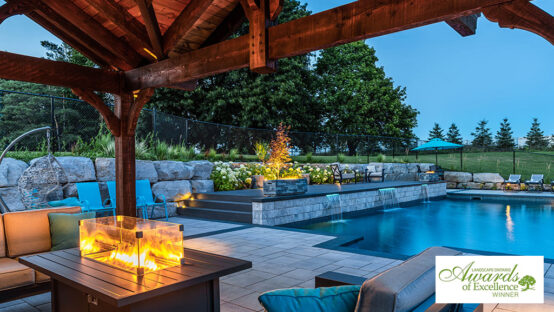
A professional pool designer studies the sun path and the root zones, then places the pool where it gets the most sun and loses the fewest roots. Placing the pool upwind of the trees, so the prevailing wind carries leaves away from the water, also cuts down the cleaning.
4. Choosing the Pool Type
The pool type matters near trees. Concrete (gunite) shells are the most root-resistant and can be shaped around a tree, but they need a larger dig. Fiberglass shells install quickly, which shortens the time roots are exposed. Vinyl liner pools are the most vulnerable to roots and falling branches because the liner can be punctured. Our concrete pool installation guide covers how the shell is built.
5. Planting the Right Trees Later
If you want new shade near the pool, choose the species with care. Avoid willow, poplar, silver maple and other aggressive rooters, and avoid heavy droppers such as mulberry. Our guide to pool landscape plants for Ontario lists better options.
By choosing a reputable pool contractor in Toronto, you get a layout that balances function and beauty without unnecessary tree loss.
Book a Free Pool Site Assessment!
How We Protect Trees During Pool Construction
Protecting a tree is mostly a matter of order. Each of these steps happens before or during excavation:
- Survey and measure. We locate every tree on the lot and within reach of the work, including a neighbour’s, and measure the trunks.
- Check the protection status. We confirm which trees are protected and whether your property falls in a ravine or natural feature area.
- Bring in the arborist. A certified arborist assesses tree health, maps the root zone and writes the Tree Protection Plan.
- Adjust the design. The pool shape, location and deck level are changed to keep the dig outside the critical root area where possible.
- Fence the zone. Protective barriers go up before work starts, and equipment, soil and materials stay outside them.
- Dig carefully near roots. Where roots must be exposed, hand digging or air-spade excavation helps, and the arborist makes any root cuts cleanly.
- Restore the soil. After construction, compacted areas are loosened and the tree is watered and watched through the next season.
Our landscape design and construction process shows where these checks fit into the overall schedule.
When (and Why) You’ll Need an Arborist
Where trees are close to the work area, an arborist is one of the first people involved. The City recommends one to measure the Tree Protection Zone, and a Tree Protection Plan is needed whenever construction is near a protected tree. The by-law also lists an arborist report among the documents for a tree permit application, although staff may waive it for some non-commercial projects.
1. Legal Requirements
If your property has protected trees or falls under Toronto’s tree by-laws, a certified arborist helps you show that the pool complies with them. Any permitted tree removal must be done by, or under the supervision of, an arborist.
2. What Arborists Do
An arborist examines root spread, tree health and construction impact. They identify which trees can be kept, which roots can be pruned safely, and where soil or structural support is needed. They also tell you which trees are already in decline and may be a risk to the new pool.
3. Team Collaboration
A pool contractor and a licensed arborist working together make a pool design that respects the existing trees and still meets your goals. The best time to involve the arborist is before the design is final, because changes are cheap on paper and expensive once the excavator is on site.
The Real Cost of Trees in Pool Construction
Keeping or removing trees both add costs, so they belong in the early budget. Typical items to plan for:
- Arborist report and Tree Protection Plan: a professional fee that should be paid before the design is finalized.
- Permit review time: tree permits can slow the schedule if they are started late, so apply early.
- Slower excavation: working around roots takes more precise, and more time-consuming, digging.
- Structural reinforcement: if roots limit soil stability, extra support may be needed for the pool shell or patio.
- Tree removal and stump grinding: necessary for trees in the pool or deck footprint.
- Replacement planting: required in some permitted removals.
- Fines and remediation: avoidable, but they can run into the thousands if a protected tree is damaged without a permit.
Hiring a knowledgeable pool company in Toronto saves money in the long run, because the tree questions are answered before construction, not during it. For a full picture of what a project costs, see our backyard landscaping cost guide.
Common Mistakes Homeowners Make With Trees and Pools
- Removing a tree first and asking later. A protected tree cut down without a permit can mean fines of up to $100,000 per tree.
- Measuring the wrong thing. The canopy is not the root zone. Roots usually reach beyond the dripline.
- Piling soil against a trunk. Raising the grade at the base during construction can kill a tree over a few seasons.
- Leaving stumps in the footprint. They decay and leave voids under the deck.
- Ignoring the neighbour’s tree. Its protection zone can reach into your yard.
- Picking the cheapest quote. If a contractor never mentions trees, ask who is responsible for the permit and the arborist.
FAQs
1. Can I build a pool close to a tree?
Yes, but how close depends on the species, the trunk size and Toronto’s tree rules. For a private tree 30 cm or more across, the City’s Tree Protection Zone starts at 2.4 metres from the trunk and grows with the trunk size, and work inside it needs a permit. A site visit with an arborist tells you how much room that tree needs. Freeform shapes, a raised deck or a shifted pool location often keep the tree and still give you the pool you want.
2. Can you build an inground pool under a tree?
Directly under a canopy is rarely a good idea. The dig would cut through the main root zone, and the tree usually suffers for it. Leaves, seeds and sap would also drop into the water every day, and branches can fall onto the pool or deck. If the tree is healthy and protected, the pool is normally placed outside the canopy edge instead.
3. Will I be fined for removing a tree without a permit?
Possibly, yes. Toronto’s Tree Protection By-law sets court fines of $500 to $100,000 per tree for convictions, plus a special fine of $100,000. The City can also charge a contravention inspection fee and order the owner to fix the damage. The permit rule applies to private trees with a trunk diameter of 30 cm or more and to many trees in ravines at any size.
4. How do I know if my tree is protected in Toronto?
Measure the trunk at 1.4 metres above the ground. Divide the circumference by 3.14 to get the diameter, and a private tree of 30 cm or more is protected. Trees of any size in a protected ravine or natural feature are covered, and so is any street tree. Toronto’s ravine map shows whether your property sits in a protected area.
5. Can tree roots damage my swimming pool?
They can damage parts of it. Roots rarely crack a well-built concrete shell, but they can push into plumbing lines, lift decks and patios, and puncture a vinyl liner. Species with aggressive, moisture-seeking roots, such as willow, poplar, silver maple and Manitoba maple, cause the most trouble. Planning the layout around the root zone is far cheaper than repairing damage later.
6. Should I remove all the trees around my pool?
Not necessarily. Healthy trees add shade, privacy and property value, and a protected tree cannot be removed without a permit anyway. Trees that are dying, leaning toward the house, or the kind that drop heavy debris are the usual removal candidates. An arborist’s opinion plus a good pool design usually leaves you with a short list of trees that really need to go.
7. Do I need an arborist to build a pool near a tree?
In many cases, yes. The City recommends an arborist to measure the Tree Protection Zone, and a Tree Protection Plan is expected when work is near protected trees. An arborist report can also be part of a permit application, although staff may waive it for some non-commercial projects. An arborist also supervises any permitted removal or root work.
8. Can I remove a tree after the pool is installed?
You can, if it is not protected or you have the permit, but it costs more and carries more risk. The crew has to take the tree down without dropping it on the pool, and the stump grinder must not disturb the deck. A large removal can also change soil moisture near the shell. Decide on every tree before excavation if you can.
9. Can I leave a tree stump near the pool?
Not inside the pool or deck footprint. A decaying stump leaves voids in the soil, and the ground above it can sink. A stump outside the building area can often be ground down and left. Note that Toronto treats a stump of 40 cm or more across, measured at 0.3 metres, as evidence of a protected tree when no trunk is left to measure.
10. Can I put an above-ground pool under a tree?
It is possible, but it is not a good spot. Falling branches, sap and constant leaf drop are hard on the liner and the water. Roots and rocks under the pool also make levelling difficult. The tree rules still apply if you dig, level or build a deck near a protected tree, so check the trunk size first.
11. Do trees make the pool cold or dirty?
Shade keeps the water cooler, so a pool that gets little direct sun may need a heater or a cover to extend the season. Trees also add leaves, seeds, pollen and sap, so the skimmer and filter work harder. Choosing the pool location away from the heaviest-dropping trees reduces both problems.
12. Does Land-Con handle the tree permit and arborist for a pool project?
We plan the pool around the trees on your lot and coordinate with a certified arborist and the City where a permit is needed. Because one in-house team designs and builds the pool and the surrounding landscape, the tree protection is built into the schedule instead of added afterwards.
Trust a Leading Pool Company in Toronto
Building a pool takes more than a contractor. You need a pool company in Toronto that understands the soil, the trees, the local by-laws and how you plan to use the yard. Whether you are working around mature trees or starting with a blank lot, our in-house team handles the design, the permits, the arborist coordination and the construction, and we back structural work with a five-year transferable workmanship warranty. Our swimming pool design expert in Toronto page shows how we plan a yard from the first sketch.
Do not let tree questions delay your pool. Call us at 416.504.5263 or email info@landcon.ca for a free consultation and site assessment, and we will walk the yard with you and tell you what your trees mean for the design.